
Table of Contents
If you buy trophies in bulk, you’ve probably felt the squeeze from two sides.
On one side, marketing wants a “premium” look that matches the brand book. On the other, procurement wants fewer headaches: fewer breakages, fewer re-runs, cleaner documentation for sustainability reviews, and smoother repeat orders.
Acrylic trophies can hit that sweet spot—but only when you source and design them the right way. That’s exactly how we approach projects at TSM Acrylic : custom OEM/ODM, bulk wholesale, and production that’s built for real-world handling, not just pretty photos.
Before we jump in, here’s a quick “what to ask for” cheat sheet you can share with your team.
| Sustainability lever (what you ask for) | What it changes in real life | Why it matters for B2B buyers | Where this is addressed on our site |
|---|---|---|---|
| Recycled PMMA content | Less reliance on virgin petrochemical feedstocks | Cleaner sustainability story without changing the trophy look | Sustainability policy + recycled sheet guidance |
| Closed-loop scrap handling | Off-cuts don’t turn into landfill | Lower waste in mass production runs | Sustainability policy |
| Design for recyclability | Easier material separation, fewer mixed parts | Better end-of-life options (and fewer compliance questions) | Sustainability policy |
| Lightweight + durable build | Fewer transit damages and remakes | Less operational noise for distributors and e-commerce sellers | Trophy pages + sustainability policy |
| Process control + QA | Fewer defects, fewer “redo” cycles | Protects timelines, MOQs, and brand consistency | Quality control page (Custom Acrylic Product) |

Recycled acrylic trophies reduce virgin PMMA demand
Let’s be blunt: acrylic (PMMA) has a fossil-based origin. That’s not a secret, and it’s not something you should try to “spin.”
The practical move is this: use recycled PMMA content when it fits your spec. On our sustainability policy page, we describe sourcing acrylic sheets that contain recycled PMMA, including post-industrial recycled material that turns manufacturing scrap back into usable sheet.
If you already sell trophies at scale—think branch-wide employee recognition or distributor-led award programs—this matters because your footprint is driven by volume. A recycled-content option lets you keep the same clear, high-end look while cutting the demand for virgin material inputs.
For buyers who want more control at the material level, start at the base: custom acrylic sheets and then lock in the trophy design.
Post-industrial recycled acrylic and post-consumer recycled acrylic options
Not all “recycled” claims mean the same thing, and your customers can tell when you’re being vague.
In our sustainability policy, we call out two sourcing routes:
- Post-industrial recycled acrylic: scrap generated during manufacturing gets repurposed into new sheet.
- Post-consumer recycled acrylic: end-of-life products (like old signs or displays) get recovered and turned into new raw material as availability improves.
Here’s why your ops team should care: post-industrial recycled options often scale more smoothly because supply is steadier. Post-consumer can be great too, but availability can vary by region and collection infrastructure.
If you need trophy programs that repeat every quarter (sales contests, franchise awards, channel incentives), ask your supplier to propose a standard material option and a recycled-content option at quote stage. That’s the easiest way to keep lead time and consistency under control while still improving the sustainability profile.
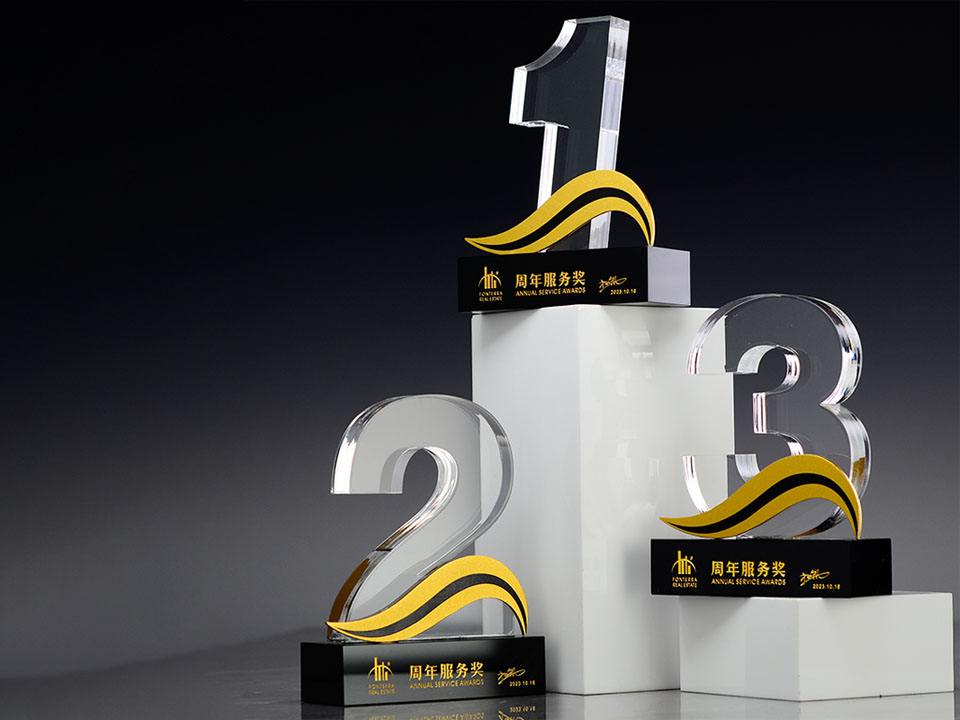
Chemical depolymerization of PMMA supports circular recycling
When people say “acrylic can be recycled,” the next question is always: How?
Our sustainability policy describes sending scrap to facilities that can reverse-polymerize PMMA back into MMA monomer, which can be used again as feedstock. That’s the core idea behind chemical recycling for acrylic.
In plain terms: instead of treating scrap like trash, you treat it like inventory.
This matters most in high-mix trophy programs where you’re doing a lot of laser cutting, CNC routing, and trimming. Those processes create off-cuts. If your supplier runs a real recycling loop, those off-cuts don’t automatically become landfill.
Lightweight acrylic trophies cut shipping emissions and damage risk
If you’ve ever managed awards for a multi-city event, you already know the ugly part: cartons get dropped, corners get crushed, and suddenly you’re scrambling for remakes.
Acrylic’s advantage is practical. It’s lightweight and still gives a glass-like look, which helps reduce damage risk during shipping and handling.
For e-commerce sellers and distributors, fewer damages is more than a nice-to-have. It reduces:
- replacement churn
- customer support tickets
- reprint/redo cycles
- ugly unboxing photos that hurt reviews
If your award needs to ship as a retail-ready unit, you’ll also want the packaging strategy to match. Our sustainability policy talks about using recyclable packaging materials and compact packing to improve shipment efficiency.
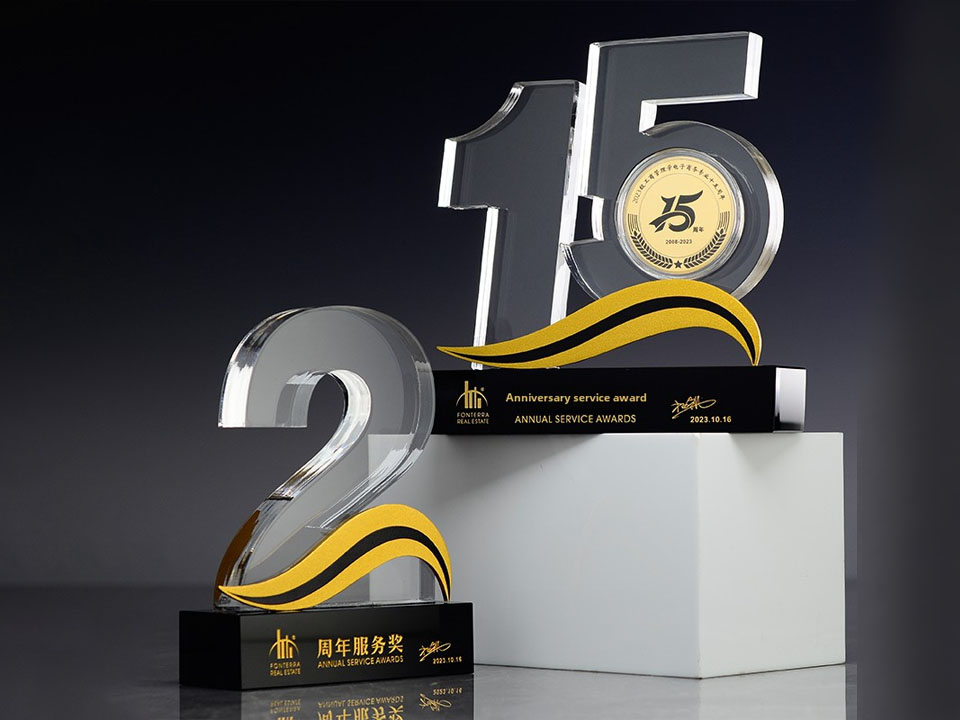
Durable acrylic awards extend product life and reduce remakes
Sustainability isn’t only about materials. It’s also about how long the product stays in use.
Acrylic trophies are often chosen because they hold up better in real environments—office desks, store counters, event booths, and travel-heavy award tours. When awards survive handling, you don’t have to keep re-ordering “emergency replacements.”
That’s especially useful for:
- corporate recognition programs that ship awards to many sites
- sports events where trophies move from venue to venue
- agency-managed campaigns where timing is everything, and rework kills momentum (Custom Acrylic Product)
If you’ve lived through the “we need 50 more by next Friday” moment, you know durability is a supply-chain feature, not a design detail.
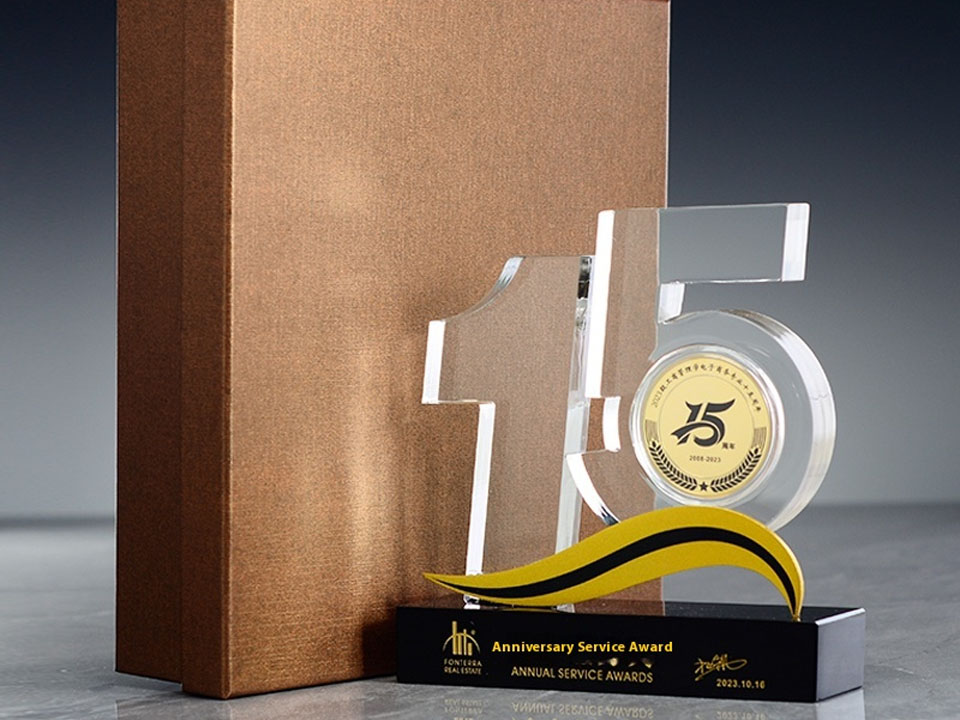
Design for recyclability and local supply chain choices
Here’s a common mistake: buyers focus on the trophy shape, but ignore the build method.
Our sustainability policy spells out Design for Recyclability principles: favor single-material constructions, reduce unnecessary blends, and use joining methods that don’t make separation impossible.
This is where good engineering pays off. If you’re ordering at scale, small design choices reduce long-term friction:
- fewer mixed materials = simpler end-of-life handling
- fewer permanent glues = easier disassembly
- smarter part geometry = less scrap during cutting and trimming (Custom Acrylic Product)
And yes, supply chain choices count too. The sustainability policy also talks about optimizing sourcing and logistics, including consolidating shipments and choosing lower-emission modes when possible.
If your team needs help turning an idea into a manufacturable spec, start with how to customize acrylic products and the acrylic fabrication guide .
Acrylic sustainability is conditional, not automatic
This is the part that makes your story believable:
Acrylic trophies aren’t automatically sustainable. They become a more sustainable choice when you combine:
- recycled PMMA content, when feasible
- a real scrap recycling loop
- recyclable-friendly product design
- packaging and logistics discipline
- solid QA so you don’t burn materials on rework (Custom Acrylic Product)
If you want to keep the message simple for clients, say it like this: “We chose acrylic because it’s durable and scalable. We improved sustainability through recycled-content options and circular handling.” That’s honest, and it matches how buyers actually evaluate materials.
Practical use cases for custom acrylic trophies and awards
Acrylic trophies work because they fit how modern B2B programs run: fast cycles, brand consistency, and repeatable production.
Corporate recognition programs
Corporate awards need brand control: logo placement, font match, color accuracy, and a design family that can scale from “monthly winner” to “annual top performer.” Our trophy page highlights engraving, color printing, and custom shaping to fit different themes.
If you want a clean starting point for bulk programs, browse custom acrylic trophies and awards or the full custom acrylic trophies & awards category .
Sports events and tournament awards
Sports awards get handled hard. They go from stage to photo wall to car trunk. Acrylic’s durability makes it a safer pick for that abuse, and the material still looks crisp under stage lighting.
Retail, pop-ups, and channel incentives
This one gets overlooked: awards don’t always live in a trophy cabinet. They sit on desks, in meeting rooms, and sometimes right near POS areas where they reinforce credibility. That’s a real branding lever, especially for retailers and distributors who want proof of performance and partnership. (Custom Acrylic Product)
A sourcing checklist you can use before you place a bulk order
- Choose a trophy design that’s production-friendly (your future self will thank you).
- Ask about recycled PMMA options and how they’ll affect clarity and color control.
- Confirm how scrap is handled (collected, recycled, or sent out for depolymerization).
- Lock in QA criteria: clarity, edges, print alignment, hole placement, final inspection. (Custom Acrylic Product)
- Make packaging part of the spec, not an afterthought.
When you’re ready to move from concept to production, it helps to work with a supplier who does OEM/ODM at scale and can keep the engineering, fabrication, and QC in one loop—especially when you’re managing tight launch calendars and distributor rollouts.
If you want, tell me what scene you’re building for (corporate program, sports event, retailer incentive, or reseller catalog). I’ll adapt this into a version that matches your exact buyer persona and keyword plan, while keeping the same proof-backed structure.









 English
 French
 German
 Portuguese
 Spanish
 Dutch
Dutch Italian